
Starting a business while balancing college life is the ultimate way to earn while you learn. Gaining the kind of practical experience that no textbook can provide is more important than simply earning extra money. Student entrepreneurship develops lifelong skills in everything from time management and marketing to handling cash flow and dealing with clients.
As we step into 2026, launching a business has never been easier or more exciting. With digital tools, social media, and AI-driven platforms at your fingertips, all you need is creativity, dedication, and the guts to get started rather than a large investment or a nice office. There are plenty of opportunities waiting for you, whether your goal is to start a small side business or a full-fledged business out of your dorm room.
College is the perfect environment to experiment, learn, and grow. Before entering the full-time workforce, it provides you with time to explore your ideas, networks, and mentorship. The best part, too? Before you graduate, you can learn actual skills, make money online, and perhaps start a career that you love.
In this blog, we’ll explore 10 best business ideas for college students in 2026 — flexible, creative, and built for the digital-first generation ready to turn ambition into action.
The Six Pillars of Profitable Student Ventures
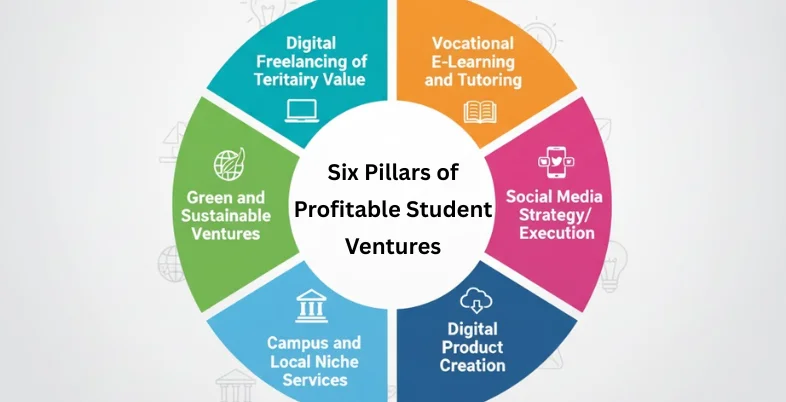
Ideas with the greatest optimal quality would be those that reduce inventory risks and provide the student with the greatest benefits of time flexibility and being digitally savvy.
1. Digital Freelancing of Tertiary Value
This will include commercializing academic capabilities.
• Niche Focus: Splicing outside the slog. Students must target niches that are relevant to their major (ex. writing B2B case studies to enterprises in the field of finance, or creating technical content to support local startups, or providing nuanced content related to some complex topic).
• Action Plan: Pick three quality samples within your niche and develop a little portfolio, and market directly on LinkedIn or entrepreneurship groups on campuses.
2. Vocational E-Learning and Tutoring
The intellectual property is an asset, marketable.
• Concentration: Provide highly prepared courses in standardized exams (AP, GRE parts), new Software ( Python classes Data Science) or new language speaking coaching.
• Model: Provide services through the online platform (Zoom, special tutoring websites) to reach as many people as possible in the entire world, and offer higher prices due to specialization.
3. Social Media Strategy/Execution
The young generation is naturally conversant with the current trends in the digital arena and as such, they are the best suited to be experts to small, local businesses.
• Do More Than Posting: Provide the full package of strategies: plan the calendar of content, analyzing the target audience, running of micro-ads, monthly reporting of performance.
• Client Base: It is aimed at the local service providers (cafes, dental clinics, small law firms) who have enough time and interest to use Instagram Reels, LinkedIn posts, and TikTok but have no time to manage it.
4. The Digital Product Creation (Passive Income)
Turn the study practices into a real source of passive income.
• Products: Create and sell digital products such as professionally formatted study notes, revision guide, Notion templates, special resume/CV templates, or planners to print.
• Platforms: Move these downloadable goods onto platforms such as Etsy, Gumroad or even plain old custom websites in order to sell them. These digital products once produced will bring in a sale with practically no external upkeep and hence a valid passion income prospect and low investment business concept to college students.
5. Campus and Local Niche Services
Tapping the local campus/immediate neighborhood needs (high-convenience ones).
• Examples: niche delivery businesses (study supplies, late-night food), niche cleaning businesses (student apartments, student dorms) or niche fitness coaching (yoga, strength training).
• Strength: These businesses have a high geographic concentration and low competition in contrast to key services.
6. Green and Sustainable Ventures
Connecting business with expanding global sustainability and climatic action demands.
• Target: eco-friendly products (reusable shopping bags in distinctive designs), bike/ e-scooter maintenance/ repair off-campus, or the beginning of an organic plant delivery and maintenance service to local business people.
• Expansion: This segment has a good visibility and good branding, which has a great appeal to the student bodies and green local customers.
List of the 10 Best Flexible Business Ideas for Students

1. Freelance Content Writing
- Approx Investment: $20 – $100
Among the most promising business ideas for college students is offering professional writing services to companies within their field of study. This goes beyond writing general blog posts — students can create high-value content such as B2B case studies, technical documentation, or web copy optimized for small firms. By leveraging their existing academic knowledge, students can deliver specialized, insightful content that stands out. This not only strengthens their career portfolio but also allows them to charge premium rates compared to generic freelancers.
2. Affiliate Marketing
- Approx Investment: $50 – $250
Affiliate marketing is the act of advertising for the owned product or services of other businesses via a specific webpage, social networks, or specifications. The student makes commission on each sale or lead which is generated through his or her unique tracking link. The model is very scalable because it does not necessarily need to engage much in managing the clients as well as employing expertise in digital marketing and search optimization to generate passive income through the traffic channeled to the affiliate partner.
3. Social Media Management
Approx Investment: $100 – $350
This business is founded on the consideration that events organisation and execution of small to medium events are highly demanded within the university or local society. Services may involve organization in campus club tournaments, small-town weddings, or corporate retreat. This sells an ability at getting things arranged, all the vendors and crisis control, which all can be done around an academic context. The venture also succeeds on the completion of a project, and good local networking.
4. Online Tutoring & Test Prep
- Approx Investment: $0 – $50
Among the best business ideas for college students, this one builds directly on their academic expertise in high-demand subjects. It focuses on specialization, such as AP Calculus preparation, computer training (like Python or AutoCAD), or even foreign language coaching. By offering online programs, students can enjoy flexible schedules, reach learners across the globe, and enhance their own knowledge while earning income. This approach not only strengthens teaching and communication skills but also turns academic strength into a sustainable source of revenue.
5. Digital Product Seller
- Approx Investment: $30 – $150
This is one of the ways to have passive income. Organizational and creative skills are turned by students into downloadable commodities. Products have personalized Notion templates to organize your studies, pretty resume/CV templates gender-neutralized to work in Applicant Tracking System (ATS), or meticulously-written, professionally-structured academic revision guidelines sold on sites like Etsy or Gumroad.
6. Websites Development and SEO Services
- Approx Investment: $50 – $200
Starting website development and SEO services is a wise and long-term decision. Students with a passion for coding, design, or digital marketing. Start small by building websites for startups, local businesses, or even your student clubs to support their online expansion. This concept maximizes learning and earning possibilities while requiring little commitment. It works flawlessly with your education schedule, enabling you to combine entrepreneurship with academics. Along the process, you’ll acquire practical experience, develop in-demand digital skills, and assemble an excellent portfolio.
Suggested Read: Digital Marketing Courses in Mohali
Digital Marketing Courses in Amritsar
7. Sell Print-On-Demand Products
- Approx Investment: $50 – $200
This would be in terms of coming up with unique designs (graphics, slogans, niche art), collaborating with a Print-on-Demand (POD) service (e.g., Printful, Redbubble). The student marketplace sells the goods through the Internet (t-shirts, mugs, phone cases) and the POD partner takes care of all the production, inventory and shipping logistics. This model demands no inventory investments and low financial risk taking advantage of design skills in order to gain scalable, passive sales.
8. Virtual Assistant (VA) to Professionals/Startups
- Approx Investment: $0 – $50
One of the smartest business ideas for college students is offering administrative and research support to professors, alumni, or startup founders. You can work online doing tasks like managing emails, setting up meetings, recording interviews, or doing quick market research. It’s a super flexible gig that fits easily into your study schedule and helps you build strong connections, gain experience, and learn how real-world projects work.
9. Graphic Design for Startups and Campus Clubs
- Approx Investment: $100 – $350
No group can do without visual communication. Design studs (Canva, Adobe Express or Figma) can provide cost-effective and high quality packages of graphic resources to campus departments, student clubs and event organizers in the town. Among the products, there are flyers, event posters, simple logos, and social media graphic templates, which offer short-term revenue to the project continuously.
10. Vlogging/Podcasting
- Approx Investment: $150 – $500
A traditional business transformed into a business that is driven by the audience using personal interests as the lever. This includes producing and selling content in a niche segment as a profitable asset like competitive gaming tips, Financial Independence (FIRE) student plans or college meal preparation tricks. Growing Monetization Adsense, sponsorship of brand, paid viewer membership becomes available after a following audience is generated.
The YouTube Wealth Comparison Table
| Business Idea | Core Skill Leverage | Approximate Initial Investment | Flexibility (Around Studies) | Scalability Potential | Recurring Revenue Potential |
| 1. Freelance Content Writing | Research, Writing, SEO | $20 – $100 (Website Domain/Tools) | High (Project-based) | High | Medium |
| 2. Affiliate Marketing | Digital Marketing, Content Strategy | $50 – $250 (Website Hosting/Ad Spend) | High (Remote/Content Production) | Very High | High |
| 3. Social Media Management | Organization, Vendor Management | $100 – $350 (Software Subscriptions/Training) | Medium (Client Retainer) | High | High |
| 4. Online Tutoring & Test Prep | Subject Mastery, Communication | $0 – $50 (Zoom Account/Mic) | High (Scheduled Sessions) | Very High | High |
| 5. Digital Product Seller (Templates) | Design (Canva/Notion), Organization | $30 – $150 (Platform Fees/Design Software) | Very High (Passive) | Very High | High |
| 6. Website Developmentand SEO Services | Coding, Digital Marketing | $50 – $200 (Basic Hosting/SEO Tools) | Medium (Client Retainer) | Medium | High |
| 7. Sell Print-On-Demand Products | Design, Trend Analysis, Marketing | $50 – $200 (Design Software/Sample Orders) | Very High (Passive Fulfillment) | Very High | Medium |
| 8. Virtual Assistant (VA) | Organization, Research | $0 – $50 (Productivity Software) | High (Remote/Flexible Hours) | Medium | High |
| 9. Graphic Design for Startups and Campus Clubs | Creativity, Design Software | $100 – $350 (Adobe/Design Software Subscription) | Medium (Short-term Projects) | Medium | Low |
| 10. Vlogging/Podcasting | Personality, Editing, Public Speaking | $150 – $500 (Mic/Camera/Editing Software) | High (Self-Scheduled Production) | Very High | Medium |
Conclusion: Starting Lean and Scaling Smart
The MVP (Minimum Viable Product) strategy of making small projects, proving the concept fast, and leveraging free online technologies (Canva, Trello, free website makers) to ensure the initial investment is close to zero is the key to entrepreneurial success during college life in 2026. When exploring business ideas for college students, this approach helps turn simple concepts into real, profitable ventures without heavy funding.
The most lucrative business ventures are those that capitalize on a student’s intellectual capital and flexible time, transforming specialized knowledge into high-margin, recurring revenue streams. With a laser focus on customer needs and smart use of academic time, students can create a strong professional portfolio and graduate not just with a degree — but with a flourishing business that continues to grow.
FAQs
1. Which is the most Important Aspect that a Student can take into Consideration when Deciding a Business Idea?
The factor that is most important is flexibility in time. The academic timetable and exam timetable should be able to fit into the business model as they are unpredictable. Most control is most easily offered by service-based models (such as consulting or tutoring) which are either project-based or scheduled on an hourly basis. Steer clear of businesses that entail fixed, physical working hours as well as large-scale inventory management.
2. Should I Bill on a Per-hour Basis or Project based on Freelance Work?
To work with a client on a regular basis, it is probably more appropriate to charge per project (or a certain fee to have a continuous work like social media management). It gives clients an idea of what to expect and encourages the student to work hard to maximize effective hourly rate.
3. What can I do to get my First Customer to a Campus Based Service?
Begin by going straight to campus organizations and student clubs or small local businesses. Give a pilot project very heavily discounted to have a pilot project and a good testimonial. Promote with the help of campus bulletin boards, special WhatsApp/Telegram groups, and LinkedIn.
4. What are the Digital Products that Students can sell to be able to receive Passive Income?
Electronic products are products which can be downloaded. Such examples can be study-planning custom Notion templates, high-tech Excel budget managers, pretty resume/CV templates exclusively tuned to ATS scanners, or custom-made academic revision guidance in a professionally-formatted form accessed on websites such as Etsy or Gumroad.
5. What will I do to maintain a Balance between Business and Academic?
The good balance involves: Automation (employing tools to, e.g., schedule/bill), Delegation (hiring of another student to handle simple tasks, when revenue begins) and strict time blocking, as a business appointment, just like in classes.
