

Have you ever wanted to know why there are millions of Indian students who prefer law as a profession? Law is no longer just the courtrooms and the judges, but it is a vibrant profession that influences the society as well as guarding the rights and promoting justice. As such disciplines as corporate law, cyber law, human rights, international law, and judicial services are booming, law degree may lead to powerful and rewarding professions. The industry statistics show that approximately 100,000 law students do graduate annually, and of this number, approximately 69,000 are successful in the All India Bar Exam, which enables them to work in any part of India.
It is only students of the best colleges of law who are likely to have the best offers in reputed firms and organizations. The country houses more than 1,700 law colleges where it is important to select the right one in order to achieve success. In this blog we will explore the 10 best law colleges in India.
Why Choosing the Right Law College Matters?
A leading law school does not only impart knowledge but makes you an assurance of a skilled individual in the field of law. Your skills, exposure, career choices and long term development all depend on the quality of your law school. The reason why the selection of the law college is so critical here is as follows:
1. Good Academic Grounding: A good law college offers a good faculty, a curriculum that is current, and profound instruction. This assists the students to have a clear perception of the main subjects such as constitutional law, criminal law, corporate law and international law. Academic foundation provides analytical skills, legal reasoning and interpretation that are critical in every legal professional career.
2. Practical Legal Training: Leading law colleges put much emphasis on practical studies and theory. This involves legal document writing, case briefing, mock trials, case legal research, and legal counselling of clients. On-the-job training equips the students with real life legal practice and makes them job-ready on the first day.
3. Moot Court Culture: Moot courts are a simulation of the real courtroom proceedings. The reputable law colleges promote national and international moot court competition that narrows advocacy, argument-making, research on the law and oratory. Moot culture instills confidence and is greatly appreciated by the recruiters and the judges.
4. Internships and Court Exposure: The most desirable law schools have organized internships in law firms, advocates, courts, non-governmental organizations and in-house counsel. Visits to the court on a regular basis and visits to legal aid clinics enable the students to see the real cases in action and have an idea of how the legal system really functions.
5. High Law School and Corporate Legal Recruits: The leading law schools are the most popular with the recruiters being corporate law firms, MNCs, banks, consulting firms and policy organizations. The powerful placement cells offer training, mentorship, and recruitment motivation to assist the students in getting good jobs and paid internships.
How to Choose the Right Law College in India?
With one of the most crucial decisions ever to be made, law aspirant should decide which law college to choose. College will define knowledge, skills, exposure and career opportunities. This is a list of 8 things that you must thoroughly consider before admission:
1. Accreditation, Recognition & Rankings: It is always important to watch whether the law college has had its approval of Bar Council of India (BCI) and UGC. The accreditation will make your degree legal practice. In addition, check NIRF ratings and NAAC scores and national reputation to know the academic reputation and status of the institution.
2. Courses:The courses offered include specializations. A good law college must also have a variety of courses such as BA LL.B, BBA LL.B, BCom LL.B, LL.B (3-year), LL.M and new specialisations such as cyber law, corporate law, intellectual property rights, international law and dispute resolution. Select a college which matches your future career aspirations.
3. Quality/ Teaching Methodology of the faculty: A good law college is made of strong faculty. Activity Research qualifications, industry experience, research production, courtroom exposure Research production, courtroom exposure, and experience are a few examples of research output, industry experience, and courtroom exposure, respectively. Colleges with case-study programs, interactive courses, legal classes with drafting and research classes with teaching offer much better results to learning than the theoretic-only colleges.
4. Field Training & Facilities: Law is a practical profession. Verify the college has a well equipped moot court halls, law libraries, law databases (such as SCC Online, Manupatra, Westlaw), drafting laboratories, and law aid clinics. Good infrastructure will directly enhance your working exposure and court room preparations.
5. Internship Support/ Industry Exposure: Inquire whether the college is an active advocate of internship. The best law schools have designed internship programs in law firms, courts, corporate legal departments, NGOs and government agencies. Frequent workshops, visits to courts, guest lectures by judges and advocates, legal aid camps are an enormous value in real life.
6. Placement Record/ Alumni Network: Study the historical placement statistics, average packages, best recruiters, internship conversion, and professional positions. The well-built network of the alumni assists students to benefit in terms of mentorship, internships, referrals and career development in the long term in the field of litigation, corporate law, judiciary and international.
7. Student opportunities and Campus Environment: The atmosphere of the learning process is important. Seek colleges which promote mooting, debates, legal research, publications, entrepreneurship and leadership positions. Competitive and helpful campus culture is a confidence and communication skill building and professional maturity.
8. Fee, Scholarships and Payback: Compare aggregate expenses, hostel expenses, scholarships and financial aid. A good law college ought to provide clear fee schemes, scholarships based on merit and high career success in such a way that your college education becomes a long-term investment, as opposed to a financial liability.
Law Courses Offered in Top Law Colleges
Top law colleges in India offer a wide range of law programs at undergraduate, postgraduate, and doctoral levels. These courses are designed to build strong legal knowledge, analytical skills, and practical exposure for aspiring legal professionals.
Undergraduate Law Courses
Undergraduate law programs are mainly integrated courses that combine law with arts, commerce, or management subjects. These are ideal for students after Class 12.
BA LL.B (Hons)
This is a 5-year integrated program that combines law with humanities subjects like political science, sociology, and history. It is popular among students interested in litigation, judiciary, and public policy.
BBA LL.B (Hons)
This 5-year course blends law with business administration topics such as management, finance, and marketing. It is suitable for careers in corporate law, business law, and legal consulting.
BCom LL.B (Hons)
This program integrates law with commerce subjects like accounting, economics, and taxation. It is ideal for students aiming for careers in corporate law, taxation law, and financial legal services.
Postgraduate Law Courses
Postgraduate programs are meant for students who already hold a bachelor’s degree and want to specialize further in law.
LL.B (3-Year)
The 3-year LL.B course is designed for graduates from any discipline. It focuses on core legal subjects and prepares students for legal practice, advocacy, and judicial services.
LL.M
LL.M is a postgraduate specialization degree in law, usually of 1 year. Students can specialize in areas such as constitutional law, criminal law, corporate law, or international law.
PhD in Law
A PhD in Law is a research-oriented program for those interested in academics, legal research, and policy-making. It involves advanced legal research and thesis submission.
Eligibility Criteria
Eligibility for 5-Year Law Courses
Candidates must have passed 10+2 from a recognized board with a minimum of 45% marks. For SC/ST candidates, the minimum requirement is 40%.
Eligibility for 3-Year LL.B
Applicants must hold a bachelor’s degree in any discipline with at least 45% marks from a recognized university.
List of 10 Best Law College In India
1. National law school of India university (NLSIU), Bengaluru.
Website: https://www.nls.ac.in/
The National Law School of India University (NLSIU), Bengaluru, is the first and most reputed National Law University in India and is generally considered to be the gold standard of legal education. NLSIU was founded in 1987 and transformed the education of law by the system of a five-year integrated law course. The university boasts of academic profundity, stringent assessment program, learning through research, and unparalleled placement performance.
NLSIU is very emphatic on constitutional studies, corporate law, public policy, and interdisciplinary research, making it one of the most respected Law Colleges in India. Students enjoy the benefits of an intellectually competitive environment, faculty, international library facilities and exposure. The university is very active in the mooting exercise, legal research, debates, policy work and judicial training.
NLSIU alumni take up most of the leading law firms, litigation chambers, judicial services, policy bodies and international organizations, hence it is a dream college of law students throughout India.
Academic and Professional Excellence
- Why it is outstanding: Father of modern legal education in India.
- Trending Courses: BA LL.B (Hons), LL.M, MPP, PhD.
- Admissions: CLAT
- Best practices: Corporate law, judiciary, policy, litigation.
- Rating: 4.6 /5
- Established Year: 1987
What Makes It Unique
- India’s first NLU
- Good moot culture and research.
- Good international image.
- Exclusive corporate and court appointments.
Course Duration:
- BA LL.B (Hons) – 5 Years
- LLM -1 Year
- MPP – 2 Years
- PhD – 3–5 Years
Eligibility:
- For BA LL.B (Hons): 10+2 with minimum 45% (40% for SC/ST)
- For LL.M: LL.B degree with minimum qualifying marks
- Admission strictly through CLAT
Fee :
- BA LL.B (Hons): ₹3.2 – ₹3.5 lakh per year
- LL.M: ₹2 – ₹2.5 lakh per year
2. NLU Delhi National Law University, Delhi.

Website: https://nludelhi.ac.in/
National Law University, Delhi is among the most selective and most respected law universities in India. NLU Delhi is in an opportune location, therefore it offers great exposure to policy making bodies, Supreme Court proceedings, and national institutions as known because of its solid constitutional law foundation and research oriented teaching method.
The university concentrates on the legal theory, study of legislation and practical legal education via clinical programs, research centers and legal aid programs. NLU Delhi has developed a good reputation in coming out with the best litigators, judicial officials as well as corporate lawyers. Its AILET entrance examination is regarded to be among the most competitive law examinations in the nation, which guarantees a highly competitive peer group.
NLU Delhi provides students with interdisciplinary legal training and effective professional placement with structured internship programs, high-impact research projects, and international academic partnerships.
Academic and Professional Excellence
- Why it is outstanding: It is based in the legal and policy capital of India.
- Popular Courses: BA LL.B (Hons) LL.M, PhD.
- Admissions: AILET
- Best in: Litigation, courts, research, leading law firms.
- Rating: 4.6/5
- Established Year: 2008
What Makes It Unique
- National-level entrance exam that is independent.
- Good research and policy orientation.
- Supreme Court exposure
- High-end placements
Course Duration:
- BA LL.B (Hons)- 5 Years
- LL.M- 1 Year
- PhD- Minimum 3 Years
Eligibility:
- BA LL.B: 10+2 with minimum 45% (40% for SC/ST)
- LL.M: LL.B degree from a recognized university
- Admission through AILET
Fee Structure
- BA LL.B (Hons): ₹2.5 – ₹3 lakh per year
- LL.M: ₹1.8 – ₹2 lakh per year
3. NALSAR University of law, Hyderabad.

Website: https://nalsar.ac.in/
NALSAR University of Law is internationally acclaimed for academic excellence, interdisciplinary studies, and corporate law training. The university has a history of high teaching quality, a strong culture of student research, and an excellent alumni network. NALSAR also has specialized research units, international exchange schemes, and industry-integrated courses that prepare students to work locally or abroad in the legal field.
The campus has a vigorous moot court, ADR and publication ecosystem, positioning NALSAR among the leading Law Colleges in India. Students are constantly attending international competitions, conferences, and cross-border academic programs. The graduates of NALSAR are not only guaranteed to be employed in the leading law firms, multinational corporations, public institutions and international universities.
The balanced approach of the institution on the subject and research, as well as skills, has placed it as one of the most respected law schools in India.
Academic and Professional Excellence
- Why it is outstanding: Excellent combination of academics, corporate law and international exposure.
- Most Requested Courses: BA LL.B (Hons), LL.M, MBA in Law.
- Admissions: CLAT
- Best: International law, corporate law, academics.
- Rating: 2.8/5
- Established Year: 1998
What Makes It Unique
- Academic partnerships in foreign countries.
- Strong alumni influence
- High research output
- Superior company recruitments.
Course Duration:
- BA LL.B (Hons) – 5 Years
- LL.M – 1 Year
- MBA in Law – 2 Years
- PhD – 3–5 Years
Eligibility:
- BA LL.B: 10+2 with minimum 45%
- LL.M: LL.B degree
- Admission through CLAT
Fee
- BA LL.B (Hons): ₹2.7 – ₹3 lakh per year
- LL.M: ₹2 – ₹2.3 lakh per year
4. WB National University of Juridical Sciences (WBNUJS), Kolkata.

Website: https://www.nujs.edu/
WBNUJS, Kolkata is a very reputed law university in India, and the one that has been very strong on matters related to corporate law learning and advocacy training. The university has a strict academic framework with well trained academics, competitive student culture and good involvement in the industry. WBNUJS focuses a lot on legal research, training at the courtroom and professional development by moot courts, ADR programs, and specialized workshops.
The students get early and uninterrupted exposure to internships, legal writing and research publications as well as live projects with senior advocates and corporate law firms, which is why it is regarded among the top Law Colleges in India. The university is also receiving a growing international presence in terms of academic partnership, student exchange programs, and other events in terms of global moot court events.
The law firms, arbitration chambers, consulting firms and policy organizations prefer its graduates, and WBNUJS is a favorite among students aiming for a high-level legal job.
Academic and Professional Excellence
- Why it is outstanding: Stable leading position in corporate law placements.
- Undergraduate Degrees Bertell, 2010: BA LL.B (Hons), LL.M.
- Admissions: CLAT
- Best in: Corporate law firms, arbitration, research.
- Rating: 4.7/5
- Established Year: 1999
What Makes It Unique
- Excellent corporate recruitment.
- Good ADR and moot court culture.
- Highly qualified faculty
- Academic exposure in the international arena.
Course Duration:
- BA LL.B (Hons) – 5 Years
- LL.M – 1 Year
- PhD – 3–5 Years
Eligibility:
- BA LL.B: 10+2 with minimum 45% (40% for SC/ST)
- LL.M: LL.B degree
- Admission through CLAT
Fee
- BA LL.B (Hons): ₹2.5 – ₹3 lakh per year
- LL.M: ₹1.8 – ₹2.2 lakh per year
5. Gujarat national law university, Gandhinagar.
Website: https://www.gnlu.ac.in/GNLU/Home
GNLU is known to have a streamlined model of legal education, learning based on specialization and a powerful research ecosystem. The university actively supports the involvement of industries, the international exposure, and legal studies of a policy-oriented character. GNLU also conducts international conferences, executive training programs, legal summits and conclaves which have given the students the benefit of good network and professional exposure.
It provides specialisation in business law, maritime law, international trade law and policy, strengthening its position among the leading Law Colleges in India. The contemporary campus, the vast legal database, the well-developed research facilities, and the training internship structure are contributing to the growth of both theoretical and real-world skills in students.
GNLU graduates are recruited in some of the top law firms, multinational companies, government agencies, regulatory agencies, and academic research centres, which makes it a good option among students who would like to work in a specialized and interdisciplinary legal setting.
Academic and Professional Excellence:
- Assets: Policy and corporate exposure.
- Why it is outstanding: Research-based and industry-focused legal education.
- Deploying Courses: BA LL.B, BCom LL.B, LL.M, PhD.
- Admissions: CLAT
- Best: Business law, maritime law, research.
- Rating: 4.6/5
- Established Year: 2003
What Makes It Unique
- Specialization-based education
- Specialization-based education.
- Intercontinental exchange programs.
- Cohesive ecosystems of internship.
Course Duration:
- BA LL.B / BCom LL.B – 5 Years
- LL.M – 1 Year
- PhD – 3–5 Years
Eligibility:
- 5-Year Law: 10+2 with minimum 45%
- LL.M: LL.B degree
- Admission through CLAT
Fee Structure (Approx.):
- BA LL.B / BCom LL.B: ₹2.2 – ₹2.8 lakh per year
- LL.M: ₹1.5 – ₹2 lakh per year
Also read: MBA Colleges in Bhopal
6. Faculty of law, University of Delhi.

Website:https://lawfaculty.du.ac.in/
The Faculty of law is one of the oldest and most renowned law schools in India, which has resulted in generations of judges, senior advocates, civil servants, and other law scholars, making it one of the prominent Law Colleges in India. The academy is well renowned as far as the depth of its academic focus in the field of constitutional law, criminal law, jurisprudence, and legal theory is concerned.
The location it is situated in the central part of Delhi offers it unrivaled exposure to the Supreme Court, Delhi High Court, law commissions and the major governmental organizations. The faculty focuses on training in litigation, legal research, drafting and preparing judicial services.
The Faculty of Law still appeals to students who want to acquire solid courtroom underpinnings and pursue careers in public service with fees that are extremely low and an ancient academic reputation.
Academic and Professional Excellence
- Why it is outstanding: Celebrity status at low cost.
- Most attended Courses: LL.B (3-Year), LL.M, PhD.
- Admissions: CUET-PG
- Best: litigation, judiciary, civil services.
- Rating: 4.1/5)
- Established Year: 1924
What Makes It Unique
- Historic legal legacy
- Very affordable education
- Strong judiciary focus
- Central court exposure
Course Duration:
- LL.B – 3 Years
- LL.M – 1 Year
- PhD – Minimum 3 Years
Eligibility:
- For LL.B: Graduation in any discipline with minimum 45% (40% for SC/ST)
- For LL.M: LL.B degree from a recognized university
- Admission through CUET-PG
Fee Structure (Approx.):
- LL.B: ₹10,000 – ₹15,000 per year
- LL.M: ₹8,000 – ₹12,000 per year
7. Government Law college, Mumbai.
Website: https://www.glcmumbai.com/
Government Law College, Mumbai is considered as one of the most iconic law colleges in India and a primary source of top corporate law firms and the Bombay High Court. GLC is one of the oldest law firms in the Indian legal fraternity having one of the strongest alumni networks in the legal fraternity. Its presence in Mumbai provides a first-hand experience to corporate headquarters, regulatory bodies, most prominent law firms, and high court litigation.
The college encourages experimentation with practical education via internships, debates, court visits as well as legal societies. The students are exposed to legal professionals, real-life cases, and corporate legal setting early in their education. GLC gets elite career results at one of the most affordable law school models in the state.
Academic and Professional Excellence
- Why it is outstanding: The gateway to high court practice and corporate law firms.
- Popular Courses: LL.B (5 years and 3 years), LL.M.
- Admissions: MH CET Law
- Best: Corporate law, litigation, legal entrepreneurship.
- Rating: 4.3/5
- Established Year: 1855
What Makes It Unique
- Strong alumni influence
- Corporate, litigation exposure.
- Affordable fee structure
- Mumbai, How to access legal ecosystem access.
Course Duration:
- 5-Year LL.B – 5 Years
- 3-Year LL.B – 3 Years
- LL.M – 2 Years
Eligibility:
- 5-Year LL.B: 10+2 with minimum 45%
- 3-Year LL.B: Graduation in any stream
- Admission through MH CET Law
Fee Structure (Approx.):
- 5-Year LL.B: ₹40,000 – ₹60,000 per year
- 3-Year LL.B: ₹35,000 – ₹50,000 per year
8. Symbiosis Law School, Pune
Website: https://www.symlaw.ac.in/
Symbiosis Law school, Pune is one of the most prominent private law schools in India with its contemporary curriculum, exposure to the international system and high-placement records. The school has an experiential approach to learning in terms of internships, moot courts, legal drafting labs, industry projects, and skill-based certifications.
Symbiosis provides a variety of foreign exchange courses, interdisciplinary courses, and career developing workshops, placing it among the prominent Law Colleges in India. Judges, corporate lawyers, policy experts and international faculty members interact with students regularly.
The company has built very good corporate placements, compliance jobs, consulting careers and in-house legal jobs. Symbiosis is among the best private law schools of choice with campus facilities that are considered world-class and a global perspective.
Academic and Professional Excellence
- Why it is outstanding: Best personal choice on corporate law exposure.
- Popular Courses BA LL.B, BBA LL.B, LL.M.
- Admissions: SLAT
- Best use: Corporate law, compliance, global careers.
- Rating: 4.⅘
- Established Year: 1977
What Makes It Unique
- Curriculum that is industry-based.
- Good moot, internship culture.
- Modern infrastructure
Course Duration:
- BA LL.B / BBA LL.B – 5 Years
- LL.M – 1 Year
- PhD – Minimum 3 Years
Eligibility:
- 5-Year Law: 10+2 with minimum 45%
- LL.M: LL.B degree
- Admission through SLAT (UG) and institute process
Fee Structure (Approx.):
- BA/BBA LL.B: ₹4 – ₹4.5 lakh per year
- LL.M: ₹2 – ₹2.5 lakh per year
9. Jindal Global Law school, Sonipat.

Website: https://jgu.edu.in/jgls/
Jindal Global Law School is an internationally standardized law school that provides an internationally oriented and interdisciplinary education in the field of law. It has foreign faculty and visiting international scholars and international research programs. Jindal is credited with bringing contemporary law specialization in data protection, international arbitration, business law, energy law and technology law.
The institution is vigorous in encouraging semester-abroad programs, joint degrees, international moot court competitions, and international conferences, strengthening its standing among the leading Law Colleges in India. Students are exposed to a lot of academic mentoring, corporate exposure, and research facilities.
Graduates are employed in multinational law firms, international organizations, policy think tanks, consulting firms and academic institutions in various parts of the globe.
Academic and Professional Excellence
- Why it is outstanding: The most internationally oriented law school in India.
- Popular Courses: BA LL.B (Hons), BBA LL.B,LL.M.
- Admissions: LSAT India
- Better with: International law, corporate law, policy research.
- Rating: 4.5/5
- Established Year: 2009
What Makes It Unique
- International faculty
- New specialties in the legal field.
- Global academic exposure
- High profile corporate placements.
Course Duration:
- BA LL.B (Hons) / BBA LL.B – 5 Years
- LL.M – 1 Year
- PhD – 3–5 Years
Eligibility:
- 5-Year Law: 10+2 with minimum 45%
- LL.M: LL.B degree
- Admission through LSAT India
Fee Structure (Approx.):
- BA/BBA LL.B: ₹6 – ₹7 lakh per year
- LL.M: ₹4 – ₹5 lakh per year
10. Lovely Professional University (LPU) School of Law.
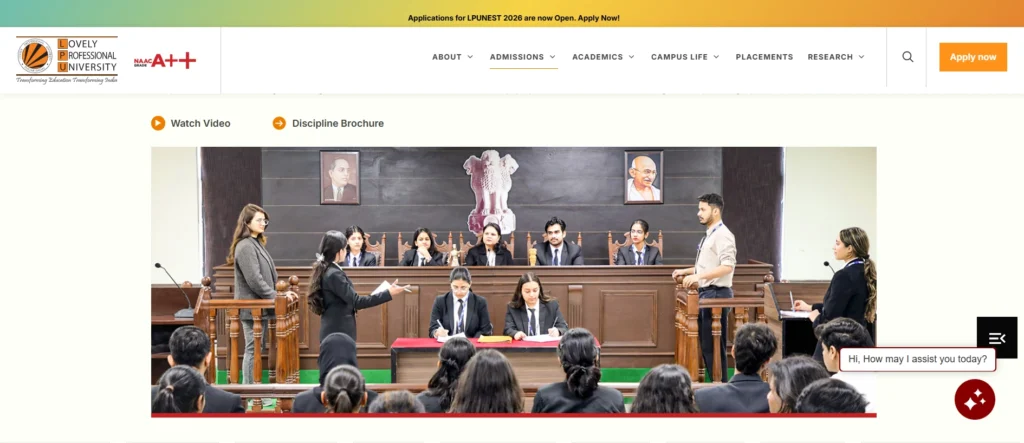
Website: https://www.lpu.in/
LPU School of Law has become one of the most progressive legal schools in India that provide career oriented legal studies with the help of state-of-the-art infrastructure and integration with the industry. The university focuses on courtroom advocacy, corporate compliance, legal technology and in house counsel training.
Moot courts, legal aid clinics, drafting laboratories, corporate internships, judicial contacts, and international scholarly conferences are all exposing students to a wide variety of exposure, which is why LPU is considered among the notable Law Colleges in India. LPU also conducts workshops and national conferences on a regular basis and also invites senior advocates, judges, and corporate legal heads as guests.
Through organized placement training, professional certifications, and high levels of recruiter interaction, LPU Law is equipping students to work in litigation as well as corporate law.
Academic and Professional Excellence
- Why it is outstanding: Good placements with contemporary legal schooling.
- The most popular courses include BA LL.B, BBA LL.B, LL.B (3-Year), and LL.M.
- Admissions: LPUNEST / CUET
- Best to: Corporate, compliance, current legal careers.
- Placement Highlights (LPU Law):
What Makes It Unique
- NIRF-ranked university
- BCI-approved programs
- Moot court and law laboratory facilities.
- Corporate-based
Course Duration:
- BA LL.B / BBA LL.B – 5 Years
- LL.B – 3 Years
- LL.M – 1–2 Years
- PhD – 3–5 Years
Eligibility:
- 5-Year Law: 10+2 with minimum 45%
- 3-Year LL.B: Graduation in any discipline
- Admission through LPUNEST / CUET
Fee Structure (Approx.):
- BA/BBA LL.B: ₹1.8 – ₹2.4 lakh per year
- LL.B (3-Year): ₹1.5 – ₹2 lakh per year
- LL.M: ₹1.4 – ₹1.8 lakh per year
Conclusion
Selecting an appropriate law college is among the most critical processes towards a successful legal career. India boasts of the best Law Colleges in India, including the most esteemed National University of Law, to the internationally inclined private law schools. Every one of the leading law schools will give a different combination of education, on-job training, exposure to the industry, and career prospects. Whereas NLUs such as NLSIU, NLU Delhi and NALSAR are still leading in national ranking, such institutions as Symbiosis, Jindal, WBNUJS, GLC Mumbai and LPU School of Law are becoming good options to the students who want more modern infrastructure, global exposure and good placements.
Your perfect college of law will be based on your score on the entrance, future career, interest in specialization as well as on your learning preferences, which is why choosing among the leading Law Colleges in India becomes so important. Through the right institution, commitment and skill training, a law degree may lead to influential, esteemed and financially fulfilling careers in India or elsewhere.
FAQs
1. What is the Best Law College in India?
NLSIU Bengaluru has a vast reputation of being the best college of law in India.
2. Which is the Best Entrance Examination to be Considered in the Best Law Colleges?
Most of the National Law Universities use CLAT as the primary entrance test.
3. Are Indian Law Colleges Good in the Private Sector?
There are good academics and placements in such private schools as Symbiosis, Jindal, and LPU.
4. What is the Best College of Law in Terms of Corporate Placements?
Corporate hiring is known in NLSIU, WBNUJS, NALSAR, GLC Mumbai and Symbiosis.
5. Will I be a Judge Having Studied Law?
You may take Judicial Services Examinations after doing LL.B.
